
.png)
Energy markets across the Western United States are preparing for a major shift in 2026 with the launch of the Extended Day-Ahead Market (EDAM). EDAM represents the first truly regional day-ahead trading framework in the West, allowing balancing authorities outside of California and the California Independent System Operator (CAISO) to participate in a coordinated optimization of generation, imports, exports, and transmission constraints.
For utilities and public power entities in the Western U.S., this means access to a much larger pool of buyers and sellers and more transparent price signals one day ahead of delivery. This update will enable flexible, low-cost resources like hydropower producers to capture more value from their capabilities, but strong forecasting technologies will be essential to realizing those gains.
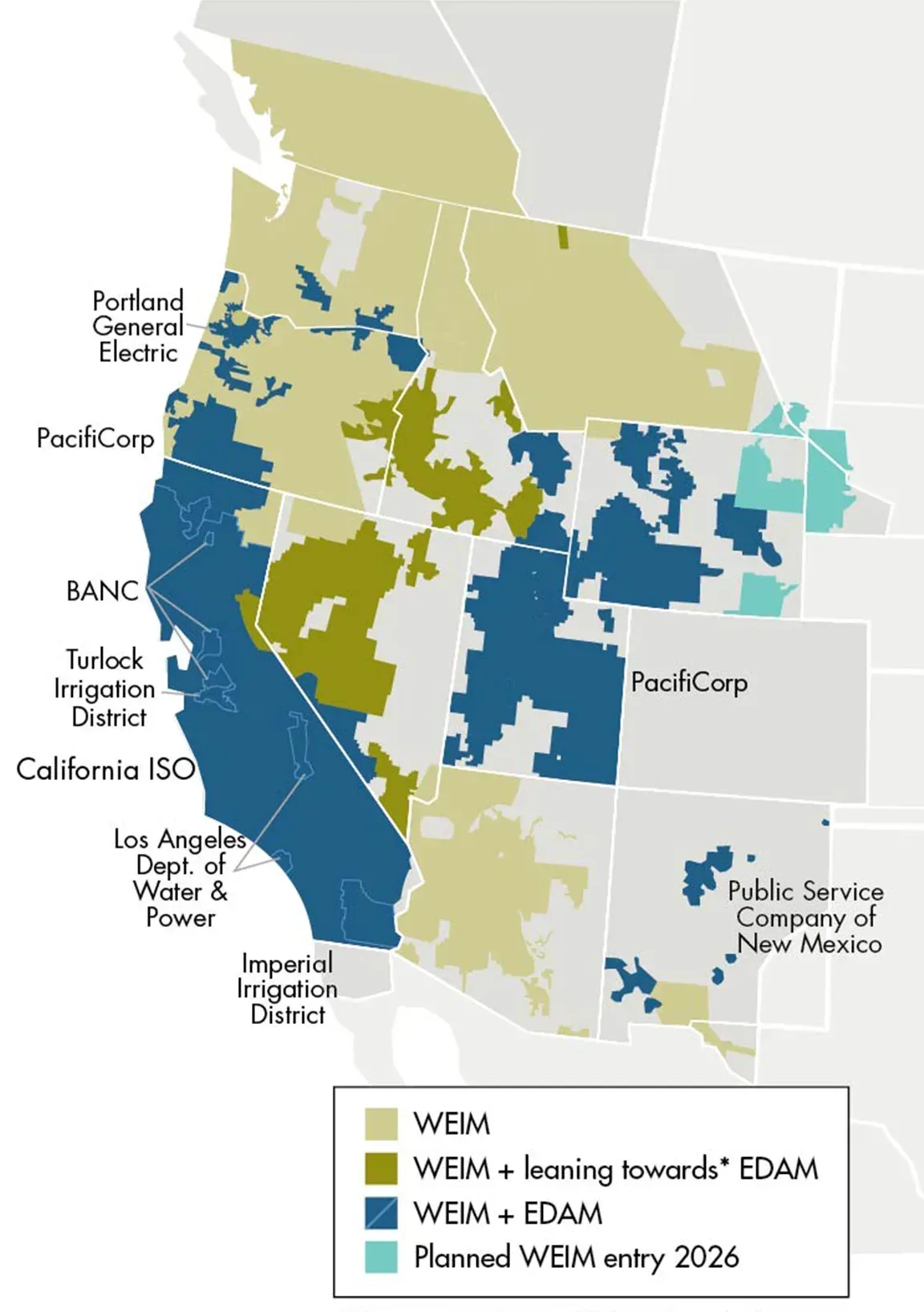
CAISO is also preparing for its own set of market updates that will reshape how flexibility is valued within its balancing area and across the broader Western market. Upcoming proposals focused on scarcity pricing and congestion-revenue allocation are expected to influence not only price formation inside CAISO, but also financial outcomes for balancing authorities participating in EDAM. As these reforms take shape in the coming months, their effects will extend well beyond California’s borders.
The proposed scarcity pricing updates, part of CAISO’s Price Formation Enhancements initiative and specific to CAISO’s balancing area, would allow prices to rise more smoothly and transparently during tight supply conditions, providing stronger price signals for flexible resources that can respond quickly. The day-ahead/parallel flow congestion-revenue allocation reforms, on the other hand, will define how transmission constraints and price differences are valued and shared across the multi-state EDAM footprint, making location-specific congestion costs more visible and financially meaningful.
For hydropower operators across the EDAM region, these changes create new opportunities to capture value while raising the importance of precision in operational planning. In a coordinated day-ahead market, short-term inflow and generation forecasts help utilities and traders anticipate when scarcity pricing in CAISO may drive higher regional prices and when congestion-revenue allocation rules will make transmission constraints more financially significant. More accurate forecasts allow operators to schedule generation into hours and locations where these signals matter most, improving bidding decisions and supporting more informed reservoir releases.
Even prior to the implementation of these initiatives, more accurate inflow forecasts have resulted in meaningful returns for hydropower operators. Our own case study at a hydropower facility trading in CAISO demonstrated that improved inflow accuracy from HydroForecast Short-term yielded an additional $6,800 in revenue per megawatt per year from improved accuracy and avoided imbalance costs. These material gains will only increase as scarcity pricing and congestion costs become a market reality.

As EDAM co-optimizes scheduling and congestion management across participating balancing authorities, transmission corridor constraints and regional price spreads will become key drivers of export value. As Amperon highlights, hydropower providers in the PNW often sell into CAISO during periods of high flows such as spring snowmelt. Short-term forecasts help these operators anticipate when transmission capacity may tighten or when high-value export opportunities are likely to arise.
As EDAM goes live in 2026, hydropower producers equipped with strong forecasting tools will be best positioned to thrive in this new landscape, improving both their financial performance and their contribution to grid reliability across the West.
To explore how HydroForecast can help you maximize revenue and navigate the evolving EDAM landscape, contact our team today.
.png)
.png)