
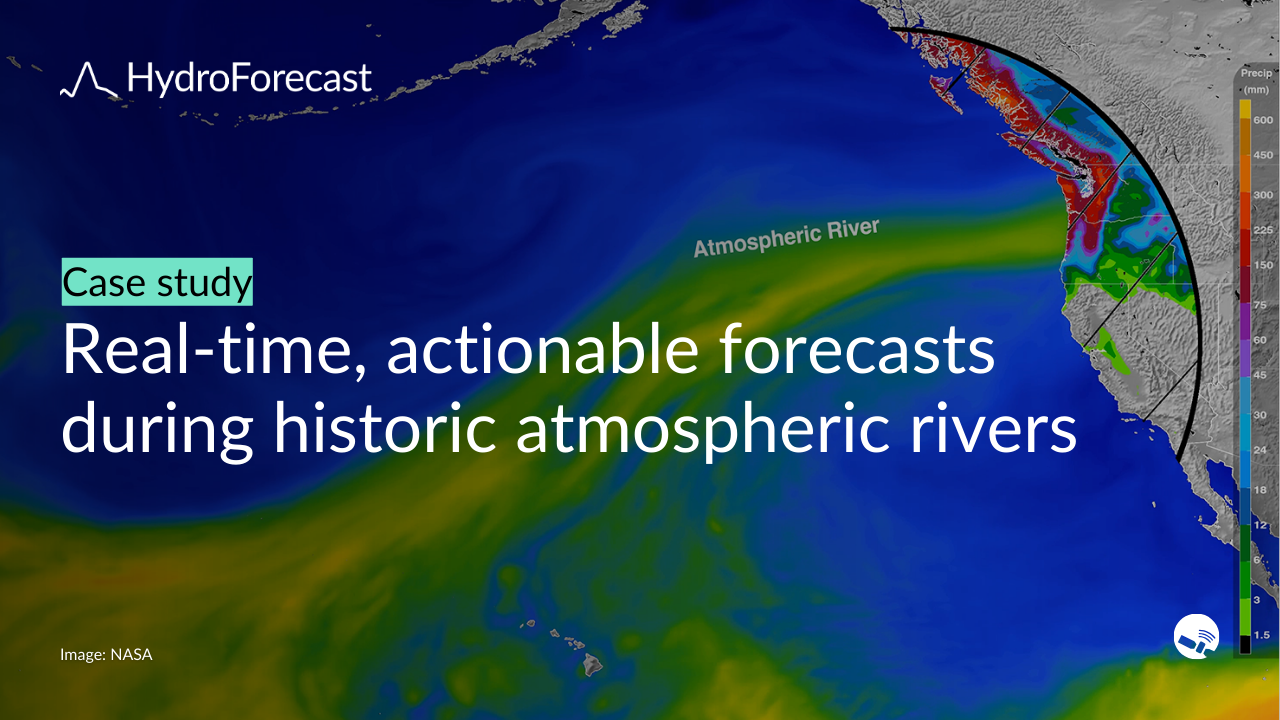
In December 2025, the Pacific Northwest (PNW) experienced record flooding that tested every aspect of water management operations. After months of severe drought, the region's hydrologists and dam operators faced a new challenge—moving from critically low reservoir levels to managing intense atmospheric river (AR) events within days.
HydroForecast identified peak flows up to 10 days in advance at multiple customer locations–four days sooner than the Northwest River Forecast Center (NWRFC) forecasts. This early warning proved critical for operators balancing immediate flood control with strategic reservoir management. Through our work across the region with customers like Tacoma Power, Seattle City Light, and Evolugen, we occupied a unique vantage point on how these ARs impacted operations.
During the storms, our team monitored forecasts closely while working directly with operators on the ground. We provided guidance and interpretation on shifting forecast trends, helping them communicate release schedules to emergency response and flood control authorities like the U.S. Army Corps of Engineers (USACE). Having this clear, reliable signal—and the expert support to interpret it—allowed HydroForecast users to ensure community safety and maintain operational control throughout these intense storms.
.png)
The first wave of ARs provided relief from drought conditions as reservoirs filled. Because reservoirs were low, operators used HydroForecast data to utilize available storage capacity—absorbing the initial surge while timing releases to maintain capacity for additional waves. With 10-day advance visibility from HydroForecast, operators were able to refill strategically, capturing water for future dry periods while maintaining the flood control capacity needed for the storms ahead. This dual objective—public safety and operational optimization—required high confidence in extended-range forecasts to support decision-making.
As conditions intensified beyond historical records, our machine learning (ML) approach provided necessary insight. By utilizing global training data, HydroForecast recognizes flood indicators even without local precedent, strengthening operators' toolkits even when conditions are outside historical records.
Managing a multi-wave storm is an iterative process. Operators relied on day-by-day, real-time updates to fine-tune their dam releases and maintain coordination with partners like USACE. These continuous forecast updates allowed teams to communicate changes to downstream stakeholders with confidence, ensuring decisions were backed by a consistent, resilient signal, allowing managers to pivot and adjust as flows evolved.
Our hydrologists were monitoring every model run and answering real-time questions. During the peak of the December storms, our team was in constant communication with our partners, providing the human layer of oversight that extreme events demand. We weren't just delivering a data point; we were ensuring that managers had the technical support and real-time validation needed to protect their assets and their communities under immense pressure.
The December 2025 ARs proved that extreme weather events are the new operational reality. Water managers can no longer rely solely on the historical record to predict future risk. True resilience is built on a modernized toolkit—one where forecasts stay accurate when conditions are unprecedented and data flows seamlessly between agencies.
Talk to our team to discuss how HydroForecast can provide the decision advantage you need for high-stakes water management.
.png)
