
Upstream Tech CTO Alden Keefe Sampson presented new research from the HydroForecast team at the 2025 AGU Annual Meeting showing how a multi-task deep learning model can simultaneously predict discharge, Snow Water Equivalent (SWE), soil moisture, and vegetation indices — all while enhancing both forecast accuracy and explainability.
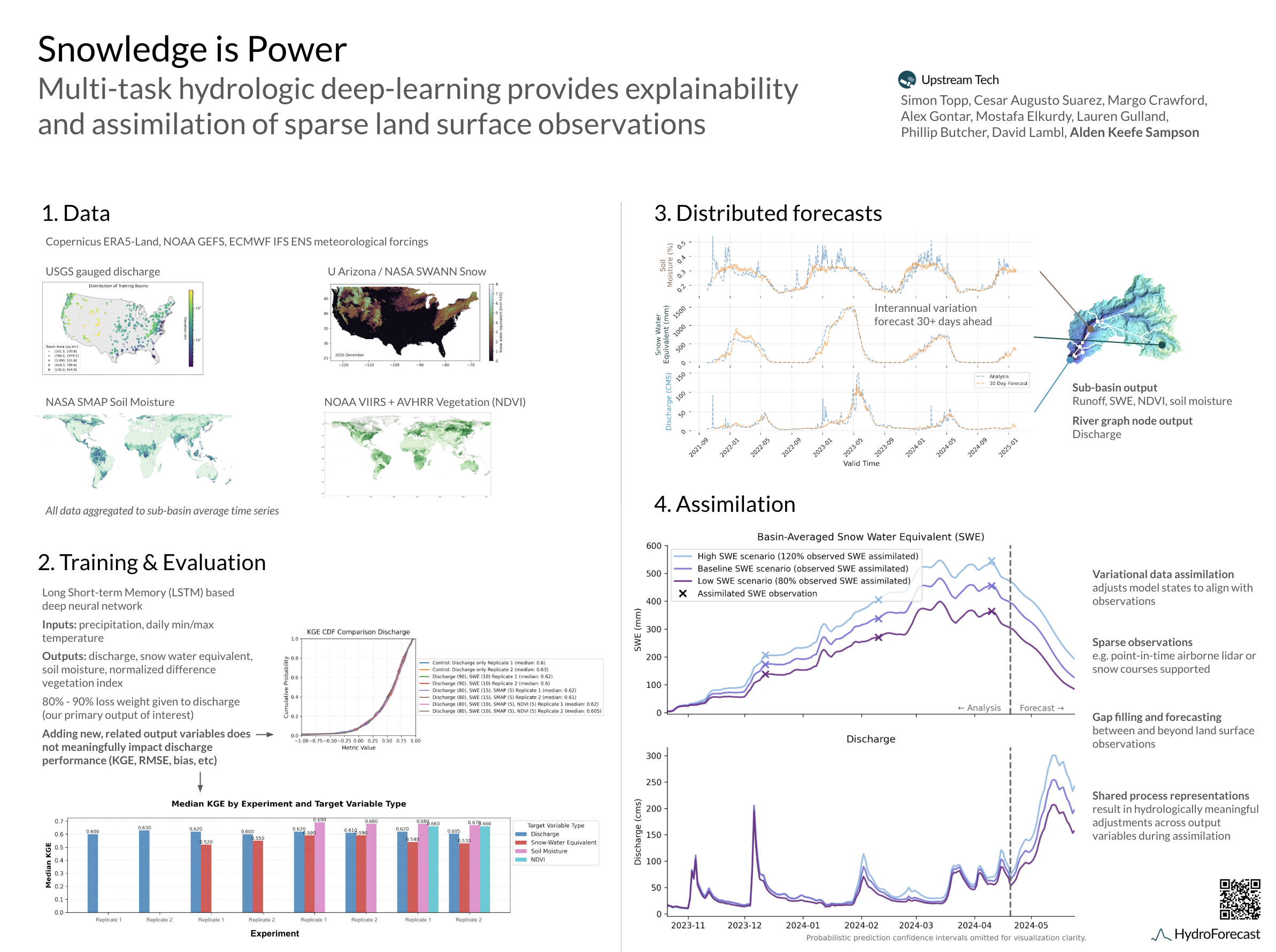
The model, built on a Long Short-term Memory (LSTM) network, takes precipitation and temperature as inputs and produces distributed forecasts across sub-basins and river network nodes. A key finding: adding related land surface outputs does not meaningfully degrade discharge performance. This matters because it means the model's internal representations are genuinely capturing hydrologic processes, not just curve-fitting to a single target.
Perhaps most practically useful is the variational data assimilation approach, which lets the model ingest sparse, point-in-time observations, like airborne lidar snow surveys or manual snow courses, to update model states in a physically consistent way. When SWE is assimilated, discharge responds accordingly, and vice versa. The result is reliable gap-filling and interannual variation forecasts out beyond 30 days, even where ground observations are scarce.
For water managers in snow-dominated basins, this kind of explainable, observation-aware forecasting is a meaningful step forward. For more information about the research, get in touch with the HydroForecast team.